When people talk about organic viticulture, they immediately think about what is not used. No synthetic chemicals, no herbicides, no systemic pesticides.
But organic farming is not merely about abstention. It is a different way of managing the vineyard — more attentive, more responsive, more closely tied to observation. At Villa Dianella this year we have made three concrete choices that capture well what it means to farm organically in the hills of Vinci.
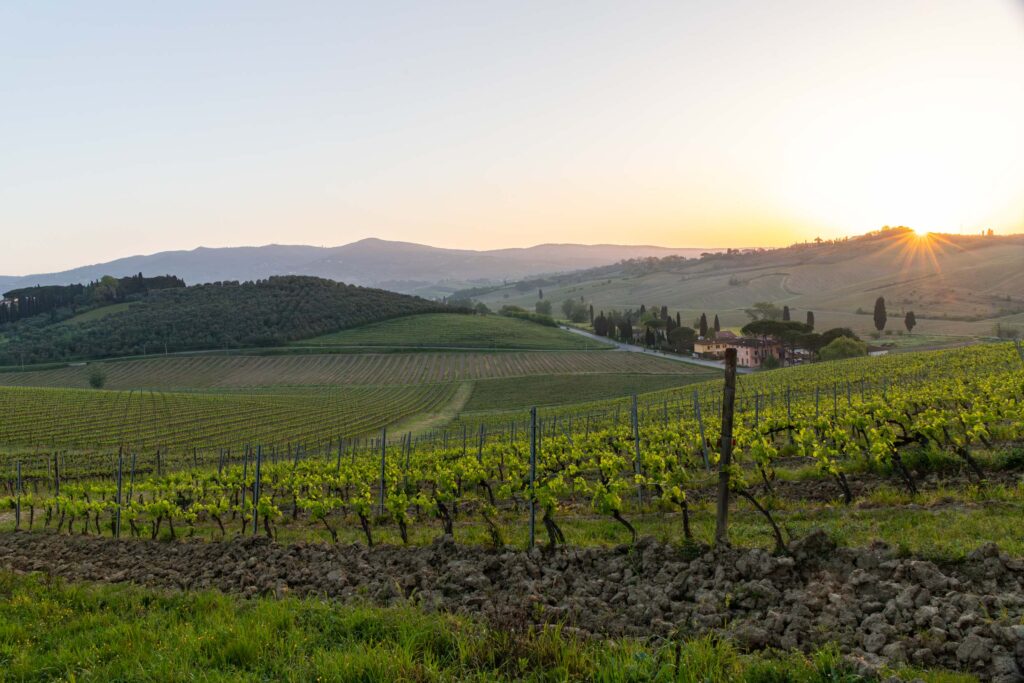
Sexual Confusion: Stopping the Grape Moth Without Insecticides
The grape moth is one of the most damaging insects for clusters. Its larvae bore into the berries, puncturing them and opening the way to moulds and rot that can compromise entire plots.
In conventional agriculture, insecticides are used. In organic farming, a smarter strategy is employed: sexual confusion.
It works like this. The female moth releases pheromones to attract the male and reproduce. The dispensers we install in the vineyard saturate the air with the same pheromone, in such quantities that the male can no longer locate the female. Without mating there is no egg-laying, without eggs there are no larvae, without larvae the clusters remain intact.
No insect is killed. The reproductive cycle is simply interrupted. It is a precise, clean and highly effective technique. The dispensers are positioned among the vine rows at the start of the season and work silently for months, leaving no residue on either the soil or the grapes.
It is the kind of solution that organic farming demands: understanding the problem, knowing the insect’s behaviour and finding a response that relies not on chemistry but on observation of nature.
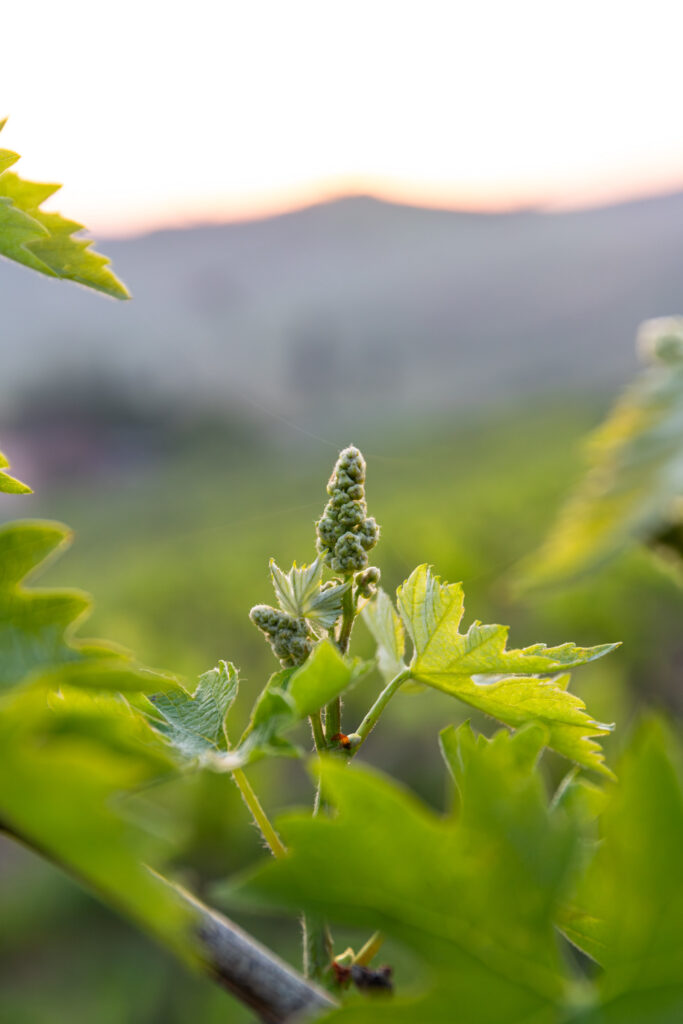
Copper and Sulphur: The Vine’s Two Historic Allies in Organic Farming
If sexual confusion protects against animal pests, copper and sulphur protect against fungal diseases — in particular downy mildew and powdery mildew, the two main enemies of the vine in a climate like Tuscany’s, where spring humidity can create the perfect conditions for these pathogens to develop.
Copper acts against downy mildew. It is a cover treatment: it is distributed on the leaves and creates a protective barrier that prevents fungal spores from penetrating the plant’s tissues. It is not systemic — it does not enter the sap. It remains on the surface and is washed off by rain, which means it must be reapplied after every significant rainfall.
Sulphur acts against powdery mildew. Again, it is a contact treatment that works through evaporation: the heat of the sun causes the sulphur to sublimate, creating an environment hostile to the fungus.
These are ancient products. Copper has been used in vineyards for over a hundred and fifty years, sulphur for even longer. In organic farming they remain the only permitted tools against the main fungal diseases, and the challenge lies in using them well: in the right doses, at the right times, without excess.
This is where the third element comes in.
The Weather Station: Treating at the Right Moment, Not Out of Habit
This year at Villa Dianella we installed a new weather station directly in the estate’s vineyards.
It may sound like a technical detail, but it radically changes the way treatments are managed. The station records in real time temperature, humidity, precipitation, leaf wetness and wind. These are the data needed to understand when the vine is truly at risk and when a treatment is not necessary.
Without a weather station, you work by calendar or by experience: you treat every so many days, you bring treatments forward as a precaution, you waste product when conditions do not require it. With a weather station, you work based on actual need. You treat when the data indicate that the risk is real.
The result is twofold. On the one hand, the quantity of copper and sulphur distributed in the vineyard is reduced, because every treatment is targeted and justified by the data. On the other, effectiveness improves, because the treatment arrives at the precise moment it is needed — not before, not after.
In a vintage with a rainy spring, as often happens in Tuscany, the difference between treating twenty-four hours early or twenty-four hours late can be enormous. The weather station provides a responsiveness that no fixed calendar can guarantee.
Organic Is Not Simple
These three things — sexual confusion, copper and sulphur treatments, weather station — reveal an aspect of organic farming that is rarely visible from the outside.
It is not an agriculture that runs itself. It is an agriculture that demands more attention, more presence in the vineyard, a greater ability to read the signals of the plant and the climate. Every decision has consequences: treating too early is wasteful, treating too late is a risk, not treating at all is a gamble no serious farmer can afford.
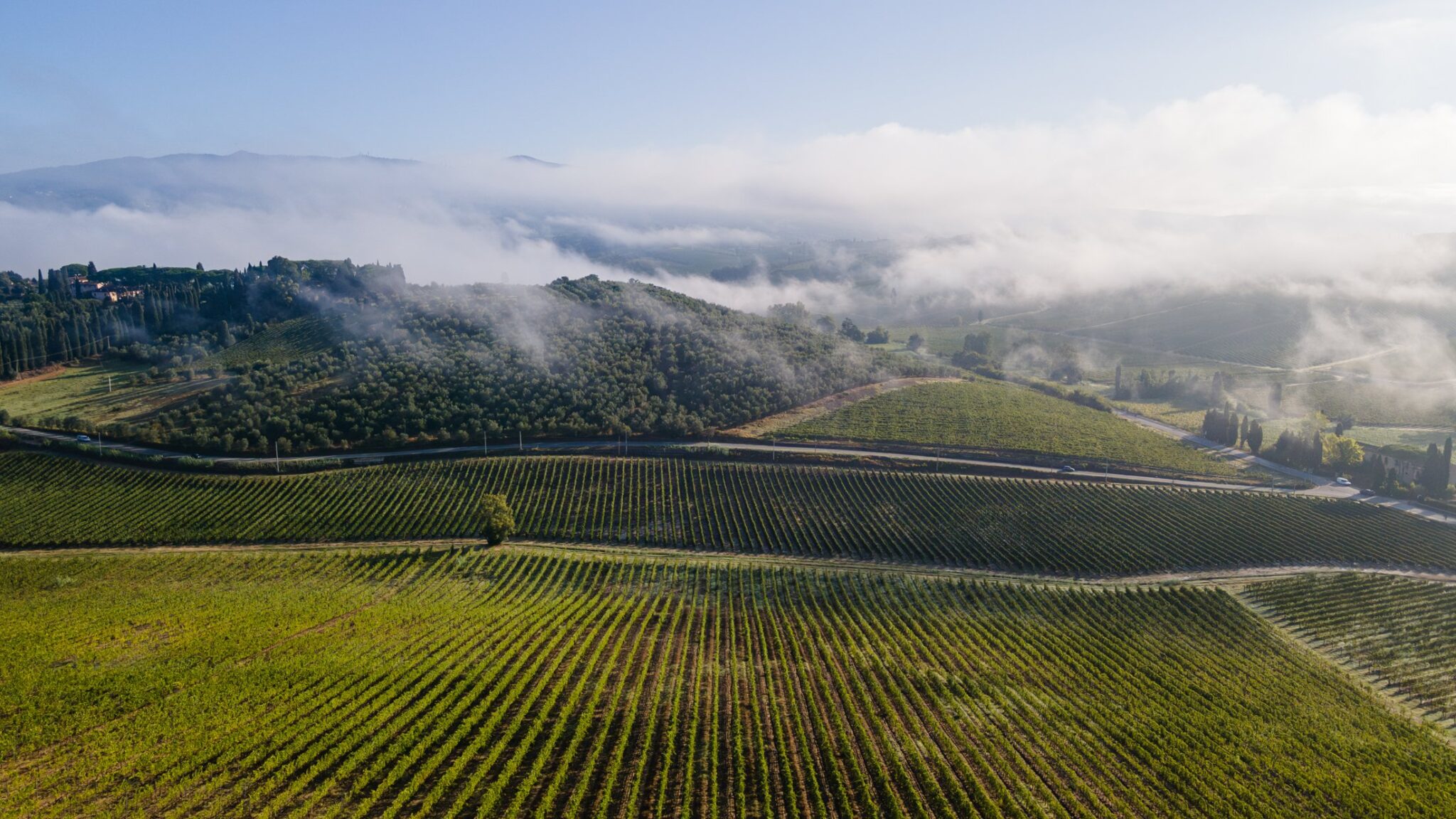
At Villa Dianella the choice to farm organically is not a marketing strategy. It is an agronomic decision, made because we believe that a healthy soil produces better grapes and that better grapes produce wines with more character. The Pliocene blue clays, the fossil sands, the soil micro-organisms: they are a heritage to be protected, not attacked.
Copper and sulphur are not perfect. No tool is. But used intelligently, guided by the weather station’s data and by daily observation of the vineyard, they allow us to protect the vine while respecting the environment in which it grows.
What You Cannot See in the Glass
Nobody, drinking a glass of Chianti Dianella, will think about the pheromone dispensers hanging among the rows, the treatments carried out at dawn before the sun dried the dew or the weather station data that guided a decision taken at six in the morning.
But it is precisely there that the quality of the wine is built.
A healthy cluster, ripened without stress, harvested at the right moment, on organic land that has maintained its vitality: this is where Villa Dianella’s wines are born. The rest is cellar technique, ageing, patience.
The vineyard comes before everything. And caring for it in the right way, every day, with the right tools, is the part of the work that is never told enough.