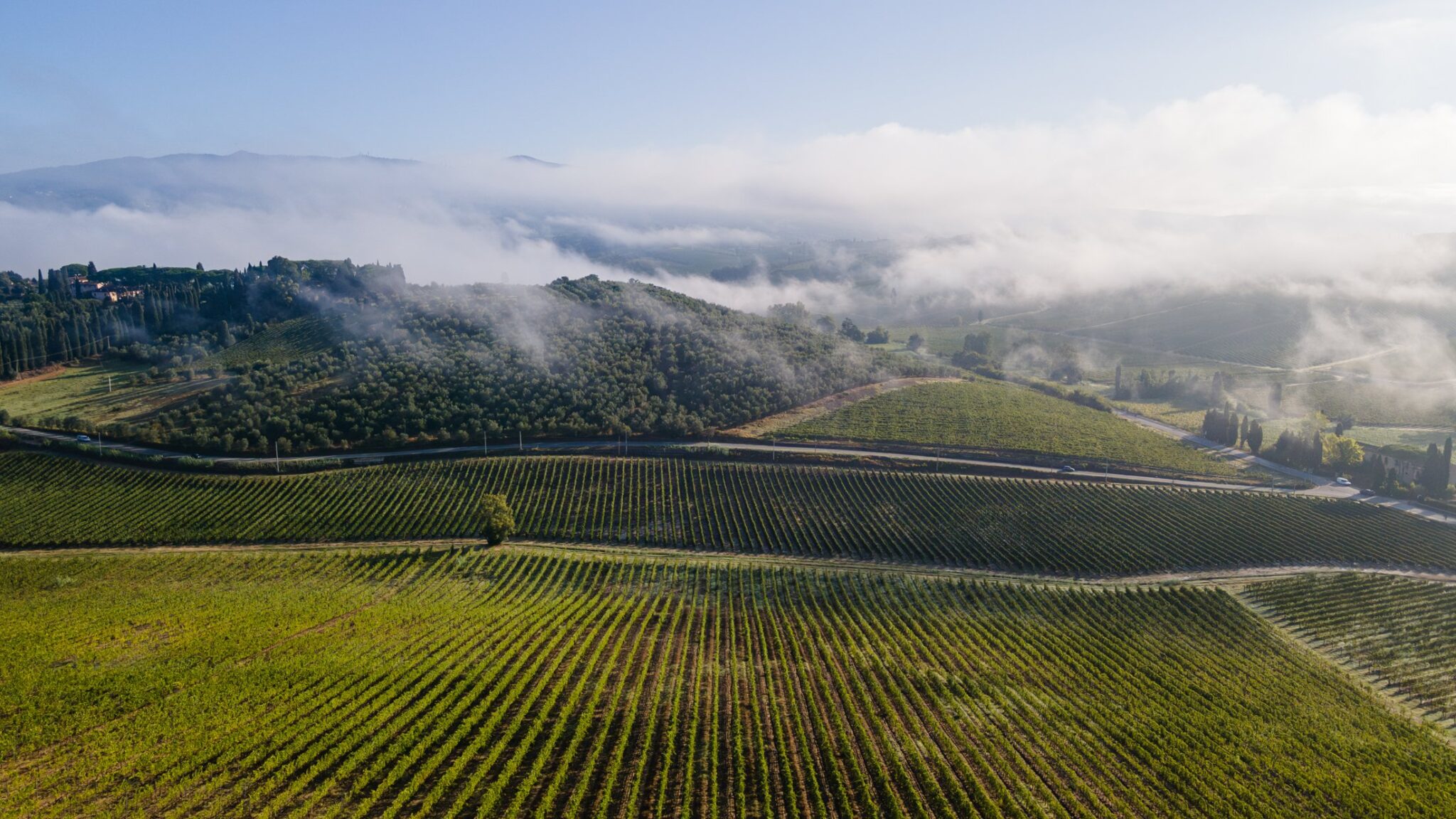
June arrived as it always does in Tuscany: with the heat turning serious and the days stretching late into the evening. After a wet May — a very wet May — summer changed gear all at once. The sun returned to dominate the hills between Vinci and Empoli, and the vineyard, charged with the water stored over the previous weeks, quite literally exploded.
For anyone who tends a vineyard organically, June is the month when the nature of the work changes. In May the fight was against grass and humidity; in June the work is on the plant itself, on its luxuriant growth, on the clusters that are forming. It is the month of canopy management, of the first thoughts about thinning, and of a defence strategy that must adapt to a completely different climate.
The balance sheet is that of a vineyard in full health — perhaps even too vigorous. May’s rain left a legacy of deep water reserves and impetuous vegetative growth. Keeping it in balance, steering it towards quality rather than towards a mass of leaves, is the real work of June.
The first small green clusters glimpsed among the leaves at the end of May have now grown. They are still small and rock-hard, but they are all there, and they already say a great deal about the vintage to come.
The Green Wall: Topping, Desuckering and Tying
With May’s water still in the soil and June’s heat pushing, the vine grows at a speed those who do not work the vineyard struggle to imagine. The shoots lengthen day by day, the leaves multiply, the canopy becomes thick and unruly.
A canopy that is too dense is a problem. It traps humidity, hinders air circulation, shades the clusters and creates the perfect environment for fungal diseases. And a plant that spends all its energy on leaves and shoots has less left for the clusters.
This is why June is the month of canopy management. We carry out desuckering — removing the suckers, the shoots that sprout at the base of the stump and on the trunk and that will never bear fruit but steal the plant’s energy. We carry out topping, cutting the tips of the over-long shoots to contain the growth and direct the strength towards the clusters. And we carry out tying, arranging the shoots between the support wires so they grow orderly, vertical, well exposed to sun and air.
It is continuous work that never stops in June. The vine grows back quickly and you have to keep up with it, pass after pass, row after row. But it is the work that builds quality: an orderly, well-aired green wall means healthy clusters, even ripening and less need to intervene with treatments.
Treatments in the Heat: Less Copper, More Balance
In May, defence was a race against downy mildew, encouraged by the constant humidity. In June the scenario changes. With the heat and the drying soil, the pressure from downy mildew falls, while that of powdery mildew rises — the fungus that loves precisely these warm, dry conditions.
The strategy adapts. Sulphur, effective against powdery mildew, becomes the protagonist. Copper, indispensable in May, is reduced: when the downy mildew risk drops, the doses come down, in line with the organic principles that require using as little as possible. Wood extract continues to accompany the treatments as a corroborant, strengthening the plant’s natural defences.
Here too the weather station installed in the vineyards is our guide. It tells us when the heat and any night-time humidity create windows of risk, and it lets us intervene only when truly necessary. Treating early in the morning, at dawn, when the air is cool and there is no wind, is the rule: the plant is protected without being stressed in the hottest hours.
The result of this balance is a vineyard that, at mid-season, is clean and healthy, with intact leaves and protected clusters, and with copper and sulphur use kept to the necessary minimum.
From Fruit Set to Clusters: The Fruit Takes Shape
After May’s flowering came fruit set: the moment when the fertilised flower turns into a berry. It is a silent but decisive passage, because it determines how many berries will make up each cluster and therefore, in large part, the harvest.
This year fruit set went well. Flowering had been regular, without the coulure that rainy springs so often bring, and the clusters that formed are compact and well filled. Now, among the leaves, they are clearly visible: small, green, rock-hard, still far from ripeness but already defined in shape.
It is at this stage that the potential of the vintage becomes clear. The berries are the size of a peppercorn and will grow throughout the summer, first swelling and then, from August, changing colour with veraison. For now they remain green and unripe, rich in acidity and devoid of sugar. But the structure is there, and this year it is good.
To look at a Sangiovese cluster in June is to look at the wine of 2026 at its youngest stage. Everything that will happen in the coming months — the heat, the water, the work in the vineyard — will be written on those berries.
Green Harvesting: Choosing Quality
Towards the end of June one of the most important and most counter-intuitive jobs of quality viticulture begins: cluster thinning, also known as the green harvest.
It consists of cutting and dropping to the ground a portion of the still-unripe clusters, sacrificing them. To anyone unfamiliar with the vineyard it seems a contradiction: why remove healthy fruit? The answer lies in balance. A vine carrying too many clusters divides its energy among them all and none ripens as it should: less concentrated berries, less colour, less structure. By reducing the number of clusters, the plant concentrates everything on those that remain.
It is a choice of quality over quantity. You give up part of the harvest to obtain a better wine. The shoots are assessed one by one, the best-exposed and healthiest clusters are kept, and the excess ones are removed — those too close together, those left in the shade.
After such a rainy May and with a vineyard this vigorous, this year’s thinning is particularly important: its very purpose is to bring the season’s abundance back within the bounds of quality.
The Soil and the Water: The Reserve Comes Into Play
In May the wet clay was a challenge: heavy, slippery, impassable. In June that same clay reveals its better side.
The Pliocene blue clays that characterise Villa Dianella’s vineyards have an extraordinary capacity to hold water. All of May’s rain stayed there, stored deep down, and now that the heat advances and the surface dries, that reserve becomes the vineyard’s treasure.
As the air turns scorching, the roots of the vines continue to find water in the deep layers of the soil. This is what allows the plants to face the summer without suffering drought, to keep their leaves turgid and ripening regular even when not a drop falls for weeks. The rainy May — tiring and complicated — is thus transformed into an insurance policy for the hot months.
With the surface finally dry, in June we return to working the soil: shallow cultivation between the rows that breaks the crust, reduces evaporation and keeps the grass under control without any need for herbicide. Dianella’s earth, which in May dictated the pace, in June goes back to cooperating.
The Balance of June: The Season Comes Into Its Own
June 2026 is the month in which the season truly took shape. The heat arrived, the vineyard exploded with growth and the work shifted from defending against humidity to building quality.
The balance is positive. The plants are healthy and vigorous — perhaps too much so — and keeping them in equilibrium demanded constant work of topping, desuckering and tying. The defence adapted to the heat, reducing copper and relying on sulphur. Fruit set succeeded and the clusters formed beautiful and compact. And with thinning, the choosing of quality has begun.
This is the rhythm of summer in the vineyard: no sudden emergencies as in May, but continuous, patient work that accompanies the plant day after day towards ripeness. Every pass between the rows, every tied shoot, every cluster kept or removed, is a small gesture that will be found again in the wine.
The clusters of the year are all there now, small and green among the leaves. The task now is to accompany them. July will bring the great heat and the first ripening, August veraison and the change of colour. But the foundation built in June — an orderly green wall, a balanced defence, the right cluster load — is what will decide much of the quality of 2026.
After May’s rain, June’s sun. The vineyard has changed gear, and with it the work of those who tend it.