May is the month when Tuscany gives its very best. The hills around Vinci are at their greenest, the estate’s kitchen garden is in full production and the kitchen works with ingredients that need nothing more than respect and simplicity.
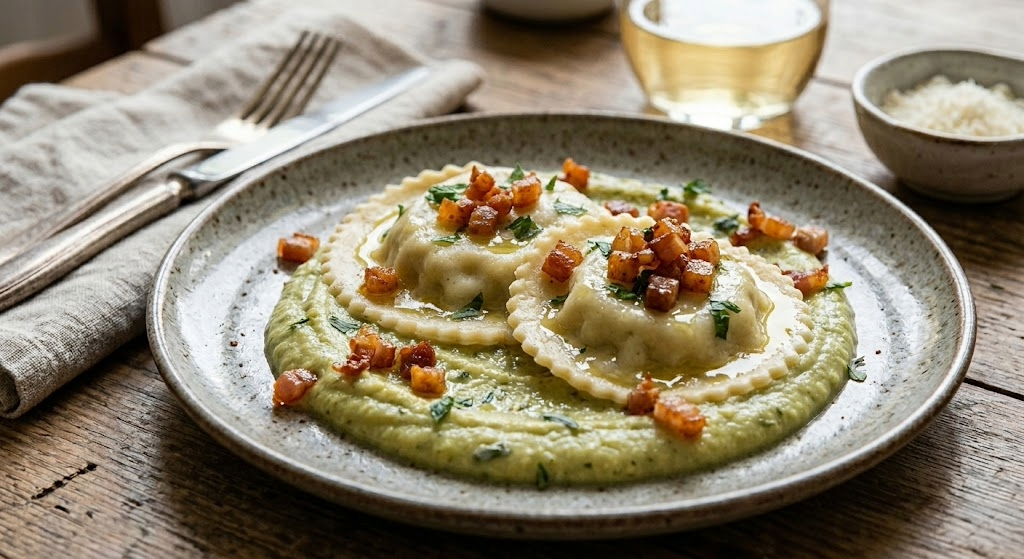
At the Bistrot delle Scuderie at Villa Dianella, the recipe of the month for May is a dish that captures this moment of the year precisely: a raviolo of melting pecorino on a cream of artichokes with nepitella and crispy guanciale. A first course that combines the softness of cheese melting inside fresh pasta, the sweet bitterness of artichoke, the wild fragrance of nepitella and the savoury crunch of guanciale.
It is a dish that appears simple, yet demands balance at every step.
The Melting Pecorino: The Heart of the Raviolo
Tuscan pecorino is one of the territory’s most distinctive cheeses. Dozens of versions exist, from fresh to long-aged, and each one tells the story of a pasture, a season, a cheesemaker.
For this raviolo, a medium-aged pecorino is used — flavourful enough to hold its own through cooking yet still soft enough to melt inside the pasta during boiling. The result is a creamy, stretchy filling that opens when the raviolo is cut and blends naturally with the cream beneath.
The challenge lies in finding the right stage of ageing. Too fresh and the filling stays wet and characterless. Too aged and it will not melt, remaining grainy. The ideal pecorino has between two and four months of maturation: still elastic, already full of flavour.
The filling is completed with a small amount of fresh ricotta to help the creaminess and a pinch of freshly ground black pepper.
Artichokes with Nepitella: The Scent of the Tuscan Countryside
Nepitella is a wild aromatic herb that grows spontaneously in the fields and along the roadsides of the Tuscan hills. Its fragrance sits somewhere between mint and oregano — fresh and slightly pungent — and it is the traditional companion of artichokes in the region’s farmhouse cooking.
Outside Tuscany, nepitella is almost unknown. Here, however, it is an ingredient that is never absent when artichokes are cooked, whether sautéed or braised. Its aroma lightens the ferrous note of the artichoke and adds a wild nuance that no other herb can replicate.
For this dish’s cream, the artichokes are cooked slowly with garlic, extra virgin olive oil and fresh nepitella, then blended to a velvety but not overly smooth consistency. A degree of texture is deliberately preserved — a reminder of the artichoke’s fibre that gives the dish character.
The cream is spread on the base of the plate and receives the raviolo, creating an aromatic bed that mingles with the melting pecorino the moment the pasta is opened.
The Crispy Guanciale: Savouriness and Contrast
The guanciale closes the dish with a note of crunch and saltiness that balances the raviolo’s softness and the cream’s sweetness.
In Tuscany, guanciale has always been part of everyday cooking. It differs from pancetta: fattier, more aromatic, with a cure that gives it an intense flavour and a texture that in cooking becomes crisp at the edges and melting at the centre.
For this dish, the guanciale is sliced into thin strips and cooked in a pan without added fat, over medium heat, until golden and brittle. The crispy pieces are then placed on top of the raviolo, where the contrast with the melting pecorino and the artichoke cream creates a play of textures that makes the dish lively and engaging with every mouthful.
The Recipe: Melting Pecorino Raviolo on Artichoke and Nepitella Cream with Crispy Guanciale
Ingredients for 4 people
For the fresh pasta: plain flour (00), 300 grams. Whole eggs, 3. A pinch of salt. A drizzle of extra virgin olive oil.
For the filling: medium-aged Tuscan pecorino, 250 grams finely grated. Fresh ricotta, 80 grams. Freshly ground black pepper.
For the artichoke cream: fresh artichokes, 6. Garlic, 1 clove. Fresh nepitella, a generous bunch. Villa Dianella extra virgin olive oil, 3 tablespoons. Vegetable stock, 100 millilitres. Salt to taste. Lemon, 1 for acidulated water.
For the crispy guanciale: cured guanciale, 120 grams sliced into thin strips.
To finish: fresh nepitella leaves for garnish. Extra virgin olive oil, raw. Black pepper.
Method
Begin with the pasta. Shape the flour into a well on the work surface, crack the eggs into the centre, add the salt and a drizzle of oil and knead until you have a smooth, elastic dough. Wrap in cling film and rest for at least thirty minutes at room temperature.
Meanwhile, prepare the filling. Finely grate the pecorino and mix with the ricotta and a generous grinding of black pepper. The mixture should be uniform but not overworked. Refrigerate until needed.
For the cream, clean the artichokes by removing the tough outer leaves, the fuzzy choke and the tips. Slice thinly and keep in water with lemon juice. In a pan, heat the oil with the garlic clove, add the drained artichokes and the nepitella, season lightly with salt and cook over low heat with the lid on for approximately twenty minutes, adding vegetable stock little by little to maintain moisture. When the artichokes are soft, remove the garlic and blend, leaving a velvety but slightly rustic consistency. Adjust the seasoning and keep warm.
Roll the pasta very thinly using a machine or rolling pin. Cut discs of approximately ten centimetres in diameter. Place a generous spoonful of filling in the centre of each disc, fold into a half-moon or cover with a second disc, sealing the edges well by pressing first with your fingers and then with the tines of a fork. Lay the ravioli on a floured tray without overlapping.
Cook the guanciale in a non-stick pan without adding oil, over medium heat, turning the strips until golden and crisp. Drain on kitchen paper.
Bring plenty of salted water to the boil and cook the ravioli for three to four minutes from the moment they float to the surface. The cooking should be gentle: the pecorino inside must melt without the pasta breaking.
Spread a generous spoonful of artichoke cream on the base of each plate, lay the ravioli on top, arrange the crispy guanciale over them and finish with a few fresh nepitella leaves, a drizzle of raw extra virgin olive oil and a grinding of black pepper.
Pairing with Villa Dianella Wines
This dish calls for a wine that can engage with the complexity of the ingredients without overwhelming them. The melting pecorino brings richness and saltiness, the artichoke a bitter note, the guanciale a smoky, savoury element.
Villa Dianella Chianti is a pairing that works well. The Sangiovese’s acidity cuts through the richness of the pecorino and guanciale, while its soft tannins find a balance with the artichoke’s bitter component. It is a wine that accompanies without dominating.
For those who prefer a structured white, Sereno e Nuvole, Vermentino IGT Dianella, can be a surprising choice. Its freshness and subtle mineral sapidity marry well with the artichoke cream and cleanse the palate after each bite of melting pecorino.
May at Villa Dianella: The Kitchen Tells the Story of the Garden
Each month at the Bistrot delle Scuderie, a dish tells the story of the season. It is not an exercise in style but a concrete way of working: you start from what the garden and the territory offer and build the dish around those ingredients.
In May the artichokes are still at their best, nepitella grows wild along the dry-stone walls of the estate, and the pecorino from local producers has reached the right stage of maturation. These are ingredients that do not travel — they make sense here and now.
The melting pecorino raviolo on artichoke and nepitella cream is a dish that speaks of the hills of Vinci in the most direct way: farmhouse tradition, honest ingredients, technique that does not show itself but is felt. At the Bistrot delle Scuderie it finds its most refined expression. At home it can become a weekend project — one of those dishes that demand time but reward with satisfaction.
The hand-made fresh pasta, the filling that melts, the cream fragrant with nepitella, the crunch of guanciale: every element has a precise role. Together they tell the story of May in Tuscany better than any words could.